Families often need to communicate with various staff members – teachers, support staff, administrators, and/or school district-level staff about their child's own experience, education, or participation at school.
Image
As a general guideline, communication should remain as close to the ‘source’ as possible. For example, if the topic pertains to something within the classroom, speak to the classroom teacher.
Social media is not an effective tool for solving concerns or challenges.
Proactive and productive parent-school relationships positively influence student success and well-being.
Prepare for Meetings
To prepare to discuss your concern, make notes on what you would like to address.
At the meeting, respectfully speak about your concern or question related to your child and collaborate with who you are meeting with to explore options for how best to deal with the concern.
Even at times when conversations are uncomfortable, it is still most productive to speak with the staff member directly involved.
If you need assistance or have questions about resolving concerns, please contact the Office of the Superintendent by phone at 250-474-9807 or email.
Steps to Resolve a Concern
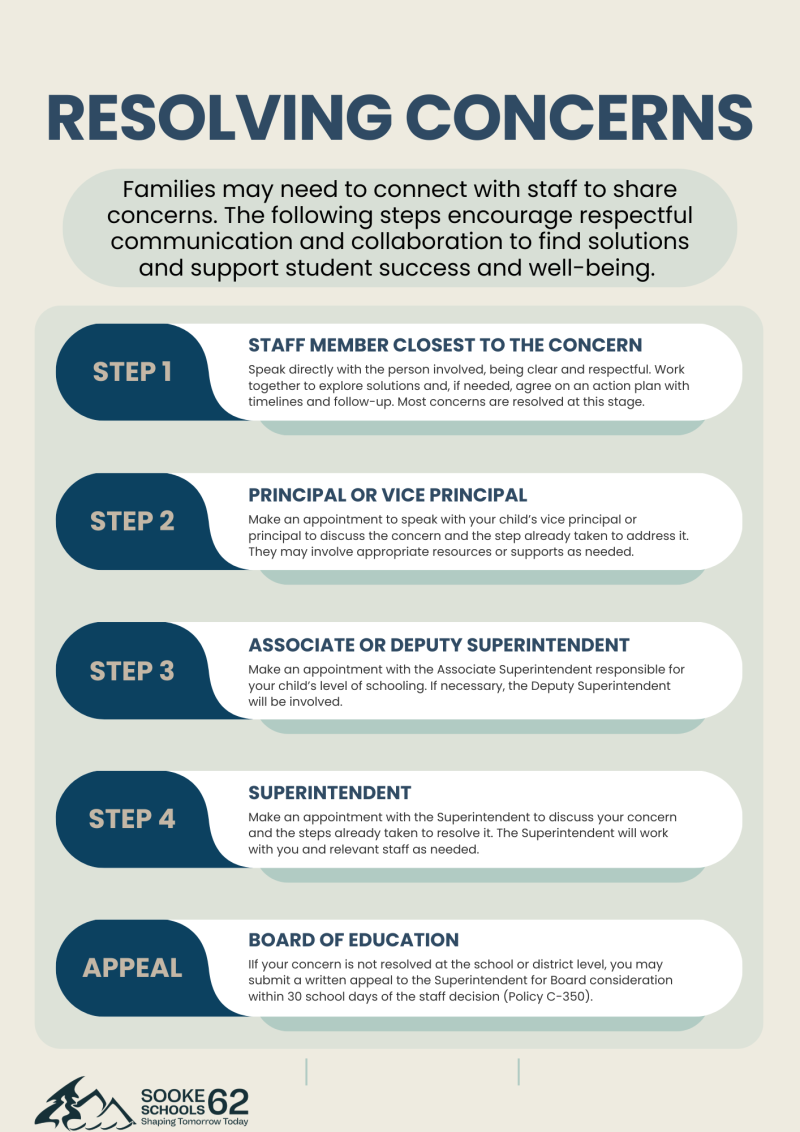
Communication is most effective at the school level. Give each of the steps a chance to correct or address the concern or challenge before you proceed to the next step.
For concerns related to the district transportation service, please contact our Transportation Department by email or by calling 250-474-9845. If you have a behaviour concern involving a student on a bus, please reach out to your child’s school principal or vice-principal for assistance.
Click levels below to expand
Speak directly to the person with whom you have a concern, one-to-one.
Be clear, concise and respectful. List examples that help to illustrate the problem or concern.
Together, explore solutions.
Together, set up an action plan with times, dates and follow-up.
If a resolution cannot be reached, inform the other person and move to the next step.
Most concerns should be resolved at this point.
Make an appointment to speak with your child's principal or their assigned vice principal (middle and secondary). Discuss the issue and what you have already done to resolve it. The principal or vice principal may involve appropriate resources/personnel as required.
If a resolution cannot be reached, inform the other person and move to the next step.
Make an appointment to speak with the Associate Superintendent responsible for the level of schooling your child belongs to.
If a resolution cannot be reached, inform the other person and move to the next step.
Make an appointment with the Superintendent. Discuss the issue and outline the steps you have taken already to try resolve it. The Superintendent will confer with the staff members involved and parent or guardian to come up with the best possible outcome.
If your concerns can’t be resolved, you can request in writing to the Superintendent to appeal the decision. This must be done within 30 school days from when a decision was first made by an employee. The decision could have been made in Steps 1, 2, 3, 4.
If a resolution cannot be reached, inform the other person and move to the next step.
Only decisions that significantly affect the education, health or safety of the student may proceed to formal appeal.
If your concerns can't be resolved at the school or district level, you can request in writing to the Superintendent for the Board to hear an appeal. This must be done within 30 school days from when a decision was first made by an employee. The decision could have been made in Levels 1, 2, 3, 4.
The appeal is held in-camera (private meeting).
Section 11 of the School Act gives parents and/or students the right to ask the Board of Education to review decisions that school employees make, or fail to make, that “significantly affects the education, health or safety of a student."
Here are some example guiding questions that can be used to prepare for and during meetings. These questions are designed to ensure communication meets the objective of supporting student success and well-being:
What is the topic/issue that needs to be addressed?
Given the student’s needs, what is our overarching purpose or goal?
What is the overall plan for the student’s education?
How would we like the student to be involved in the process of creating their educational and future goals? Does the student need to join the conversation?
What is the role of an Individualized Education Plan (IEP)?
What is our communication plan (timeline and process) moving forward?
What are the choices or options of support we ought to consider?