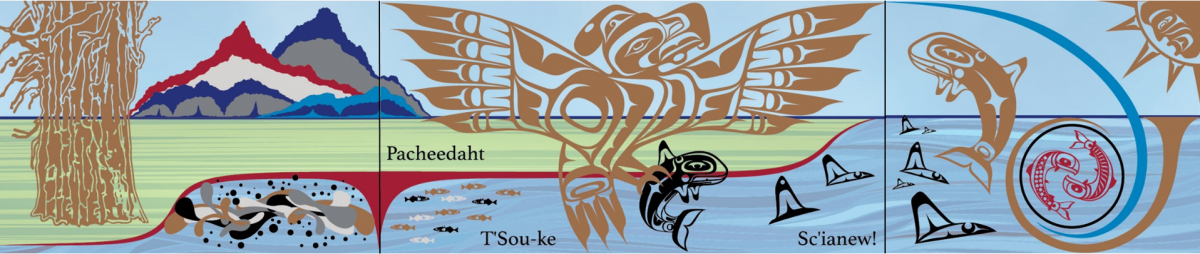
Visual Territory Acknowledgement- Artist Statement
ÍY, C̸NES QENOṈE ṮÁ- It's good to see you all!
Traditional Territory
With gratitude and respect, we acknowledge that we live, learn, and work on the traditional territories of the Coast Salish: T’Sou-ke Nation, SĆIȺNEW (Beecher Bay) Nation, and the Nuu-chah-nulth: Paaʔčiidʔatḥ (Pacheedaht) Nation. We also recognize that some of our schools are located on the traditional territories of the MÁLEXEŁ (Malahat) Nation, and the Lək̓ʷəŋən peoples of Songhees and Esquimalt Nations.
For more information, please see Territory Acknowledgment Information package.
SD62 ‘House of Learning’
Lellum (HUL'Q'UMI'NUM' Language) or Á¸LEṈ (SENĆOŦEN Language)
2025-26 school year:
Total of 1,302 Indigenous Learners (Self-identified). Of these:
- First Nations students 67%
- Métis students 33%
- Inuit students <1%
If your child self-identifies as Indigenous, please call your school secretary and let them know. After you have self-identified, please complete the Indigenous Education Program consent either online or by printing out the Consent form below and returning it to your school.
Click to view the NA'TSA'MAHT Indigenous Education programming brochure.
consent form for the 2026-27 school year
Vision
The following documents demonstrate how Indigenous education is intertwined in every day learning in Sooke School District as well the journey to get here. We value ongoing insight and input from the Indigenous Education Council (IEC) and the respective communities the members represent.
To learn more click on the links below:
- Indigenous Education Council (IEC)
- Local Education Agreements (LEAs)
- NA'TSA'MAHT Enhancement Agreement
- Equity in Action Project
Descriptions of Programs & Services
The NA’TSA’MAHT Indigenous Education Department’s goal is to enhance educational, social, and cultural opportunities for Indigenous students. By indicating on your child’s registration form that they have Indigenous Ancestry your child is eligible to receive these enhanced in-class programs and services. The options for self-identification include: Status (on or off-reserve), Non-Status, Inuit and Métis.
The programs and services are intended to improve academic achievement as well as deepen the understanding of Indigenous perspectives and content already being offered in Kindergarten to Grade 12. The programming is inclusive of all students, held in-class, with no students being pulled from class or singled out.
Examples of programs and services include:
- Indigenous Role Model presentations
- Elders-in-Residence programs
- Cultural projects and activities in classrooms and schools
- Field Trips, gatherings & special events
- NA’TSA’MAHT Family Dinner Gatherings
- Academic in-class support provided by NA’TSA’MAHT Education Teachers and/or Classroom Program Assistants
- Student & Family Advocate Teacher Support K-12
- Liaison to External Supports for Indigenous students & families
- Grade 12 Indigenous Student Events: Graduation Recognition Celebration & Land-based Celebration
- Grade 8 Land-based Transition Day
- Secondary students are also made aware of scholarships, bursaries, post-secondary options, community programs, and visits to post-secondary (Camosun & UVic Indigenous Education Fairs)
- Thunderbird Cultural Group (for students serviced by Student & Family Advocates)
Department Contacts
Main office line: (250) 474-9833
| Jon Carr | District Principal, NA'TSA'MAHT Indigenous Education |
| Connie Swan | District Vice Principal, NA'TSA'MAHT Indigenous Education |
| Katie Gaetz | NA'TSA'MAHT Indigenous Education Curriculum Coordinator |
| Lorraine Veile | NA'TSA'MAHT Indigenous Education Secretary |
| Danielle Huber | NA'TSA'MAHT Student & Family Advocate |